
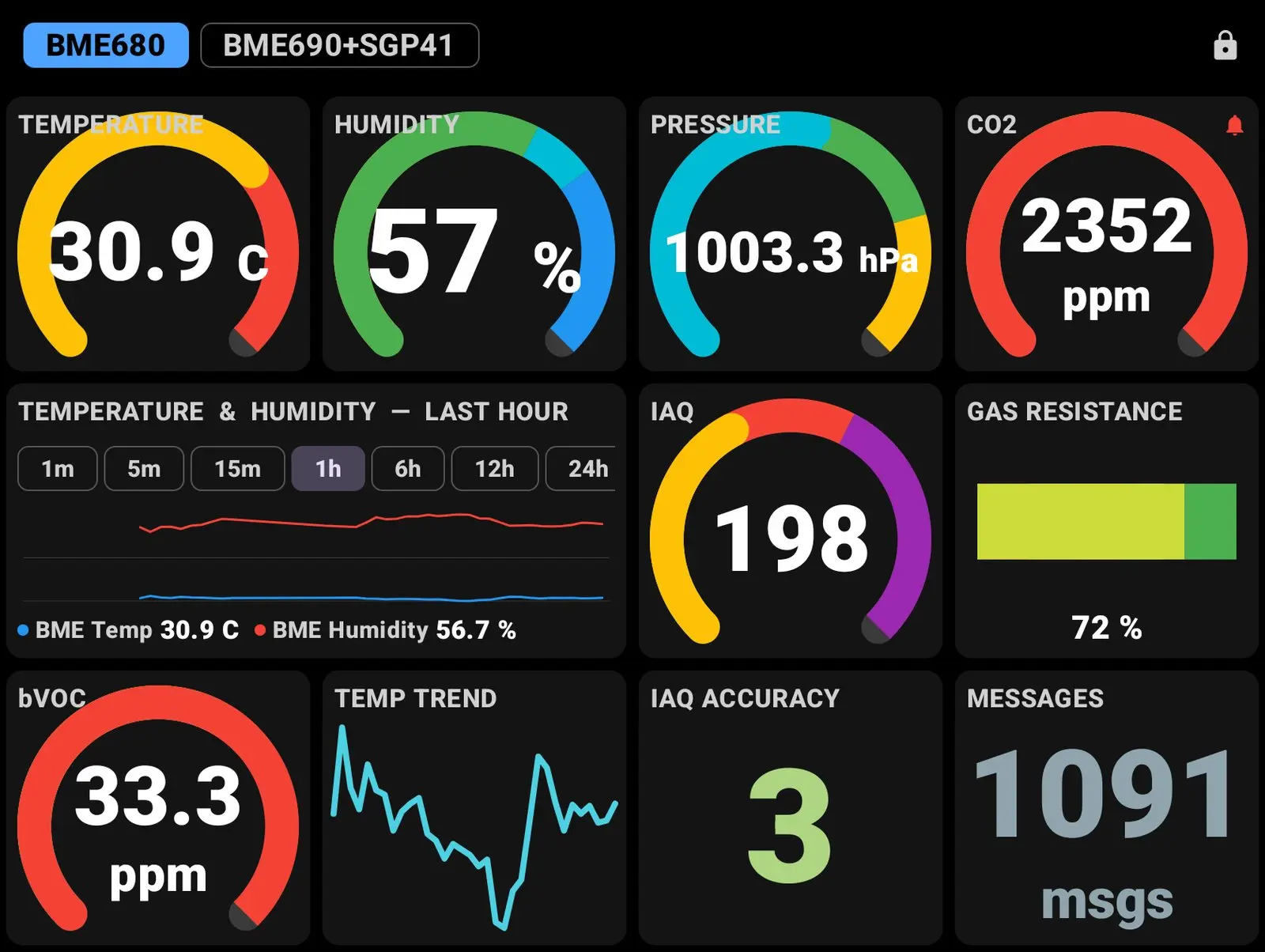
That old tablet in your drawer? Mount it on the wall.
Retained connects to your MQTT brokers and turns sensor data into live gauges, charts and indicators — on the phone in your hand, or a tablet mounted on the wall. Android 6.0 and up, so the one in the drawer works too.
dashboard
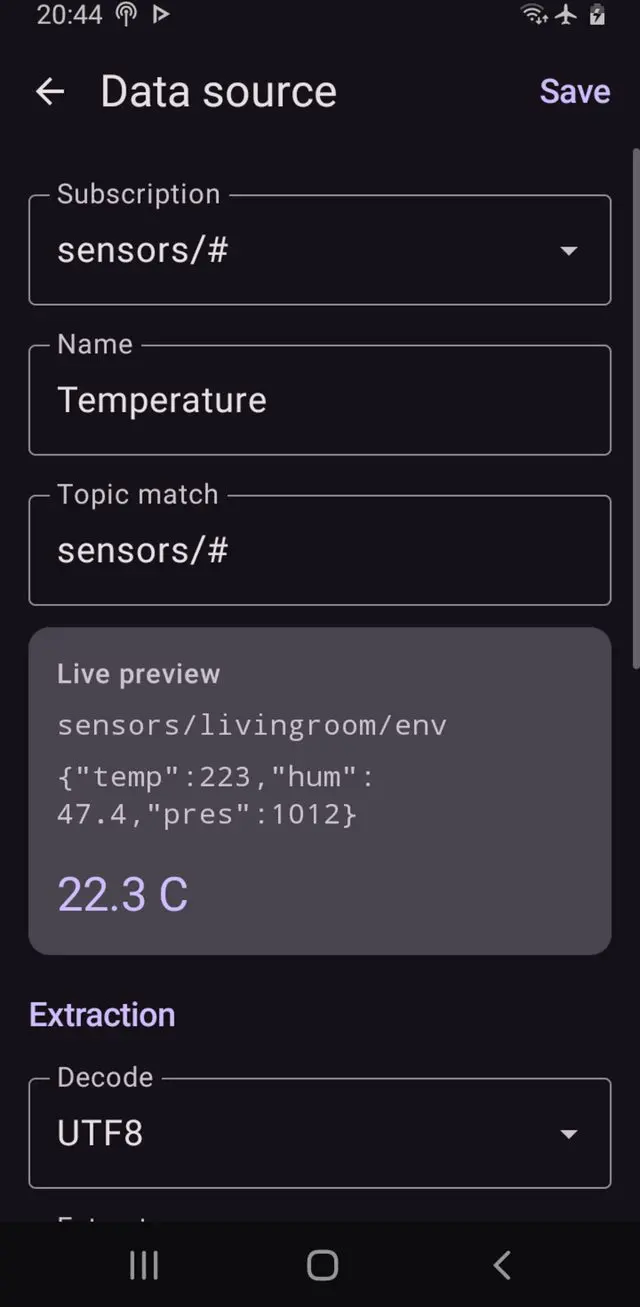
See the payload. See the value. As you type.
Point Retained at a topic and it shows you the last real message that arrived, with your extracted value updating live while you edit the path. No save-and-hope loop, no guessing whether $.sensors[0].temp was the right path.
Pull a value out of whatever shape it arrives in — JSON via JSONPath, CSV by delimiter and column, regex capture groups, or raw binary by byte offset and type (u8, i16, f32, either endianness). Then transform it: x / 10, round(x, 1), whatever quirk the sensor has.
live preview
What it does
Any broker
MQTT 3.1.1 and 5.0 over TCP, TLS, WebSocket or secure WebSocket. Username and password, client certificates, self-signed certs. Last will, clean start, session expiry. Automatic reconnect with backoff, held open by a foreground service.
Ten widget types
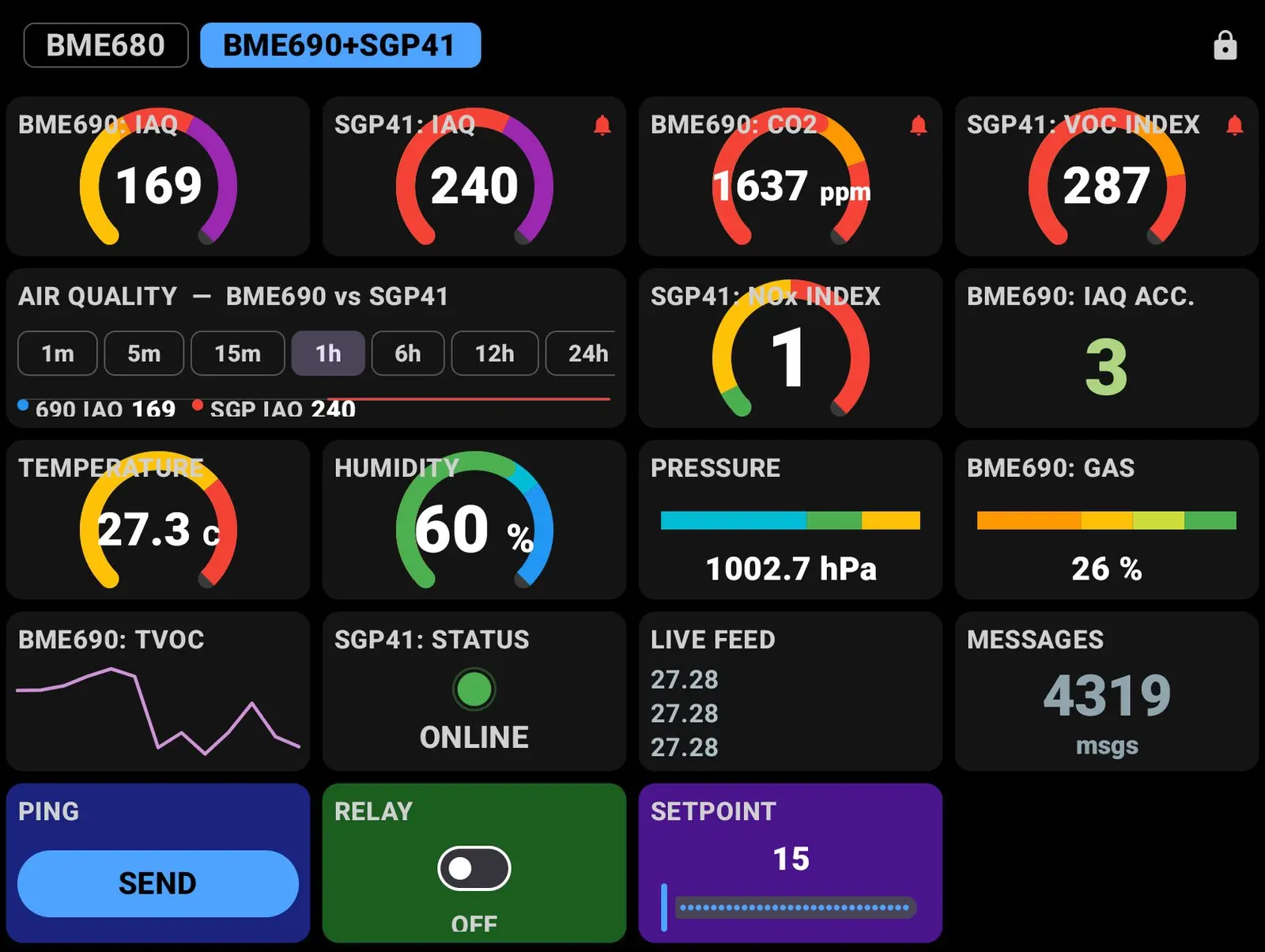
Value cards, arc and bar gauges, line charts, sparklines, LED indicators and scrolling text logs — plus buttons, switches and sliders that publish back to your broker.
Reacts to thresholds
Colour zones on gauges, and rules that recolour a widget, blink it, or raise a notification when a reading goes out of range.
One layout that reflows
Arrange a page once and rotating the device re-columns it. No second grid to keep in sync, and no widgets landing on top of each other.
Kiosk mode
Screen on, system bars hidden, editing locked out. A dimming schedule for quiet hours, tap to wake, optional PIN to leave. Full always-on engages only while charging, so an unplugged tablet is not cooked overnight.
Built for old hardware
Updates conflated to a few a second, history kept as in-memory ring buffers and downsampled before drawing, charts drawn straight to canvas. No chart library, no WebView. There is an e-paper mode for e-ink panels.
Old is the floor, not the target
Android 6.0 is the minimum, not the intended device. Retained runs on a current phone or tablet exactly the same way — it is simply built so that a decade-old one is not excluded. Phones, tablets and e-ink panels all work.
MQTT Discovery
Opt in per connection and Retained reads Home Assistant MQTT Discovery, then offers what it found as one-tap data sources. Nothing is created behind your back.
Export and import
The whole configuration round-trips through a single JSON file. Set up one tablet, move it to the next. Passwords are deliberately left out of the export.
Every widget type, one page
Two air-quality sensors on one board, read side by side: a BME680 running BSEC and an SGP41 reporting its own VOC and NOx indices. Arc and bar gauges, a two-series chart, a sparkline, an LED, a scrolling feed of the raw values — and the three control widgets, which publish back to the broker rather than only listening to it.
widgets
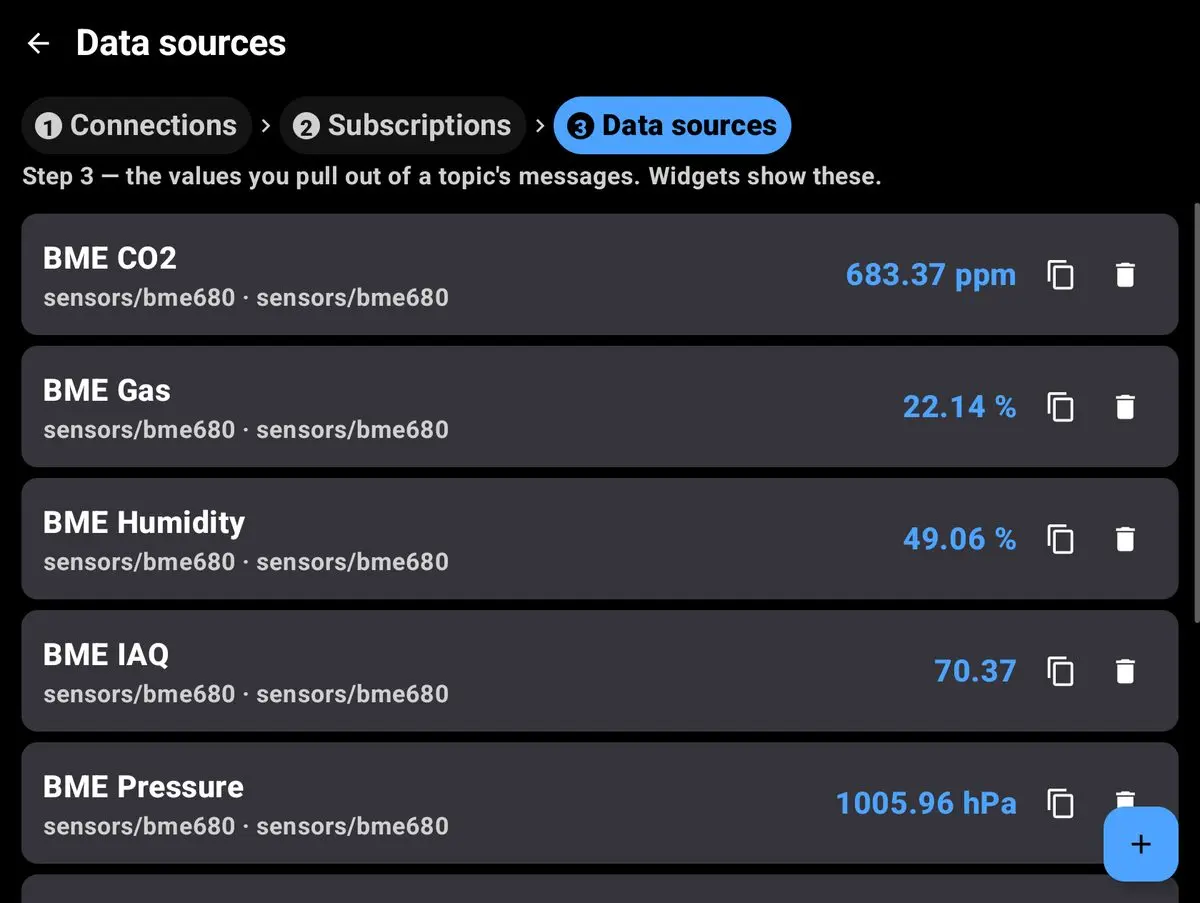
Define a value once, use it everywhere
A data source is a named value — Temperature, CO2 — not a widget. Define the extraction once and every gauge, card and chart on every page reads from it, with one shared history behind them. Change the topic later and nothing downstream needs rebuilding.
data sources
- Staleness is visible. If a reading stops arriving, the widget greys out and tells you how old it is. A frozen gauge that still looks healthy is worse than an obvious error.
- Failures are loud. A path that stops matching shows an error badge on the widget. It never silently renders the last good value.
- Multiple brokers at once. Connections are independent, so one page can mix sensors from your ESP32 broker and your Home Assistant broker.
privacy
Retained has no backend. There is nothing to sign up for, no analytics SDK, no crash reporting and no advertising. The app makes network connections only to the brokers you enter yourself, broker credentials are encrypted on-device with a key held in the Android Keystore, and uninstalling removes everything.
before you mount it
Android will kill a background network connection to save power, and that is the single most common cause of a dashboard that is dead by morning. Retained explains this on first run and asks to be exempted from battery optimisation. You can decline and the app still works — less reliably in the background. Grant it, and plug the tablet in.
Free, with no account and nothing to configure in the cloud.